Mind the Candle Grease
Listen:
Epilogue:
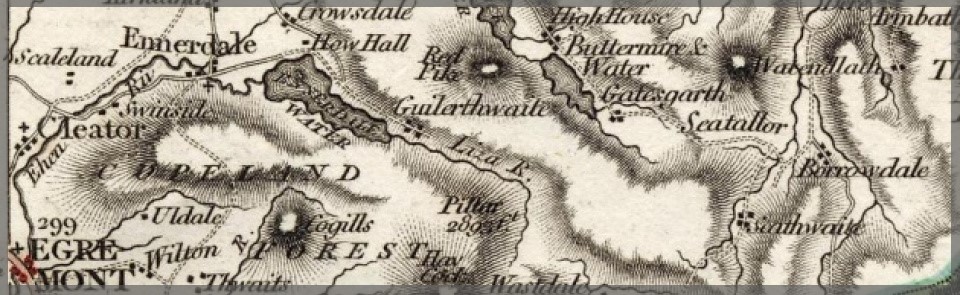
It must be a hundred years since the Wild Dog of Ennerdale roamed the fells between Egremont and Ennerdale and round behind Cleator and Cleator Moor, and kept the locals in fear of, if not their own lives then the lives of their children.
It was well known that it could easily carry a full grown Herdwick as easy as a spaniel carries a rabbit, and if it took sheep who knows if it wouldn't take a young child as he wandered on the hills in a holiday time, or left the road on his way from school on a winter eve when the nights get dark so quickly.
The farmers, and anyone who had a gun, went out and tried to shoot it, but it was cleverer than they, and they never got near enough. They even went out at night and sat and waited all night, all to no avail. They only heard the sheep bleating, and when the light came found another flock huddled together, and a few more mangled bodies.
The police were asked to do something, but what could they do? There were only about four of them in the whole district, and there were other things to do for them. There were poachers to think about who might steal the Laird's rabbits, and what a calamity that would be.
There had already been four poachers sent to prison, not many miles away, when the keeper had caught them with half a dozen rabbits between them, and had been brave enough to try and relieve them of them. They had resisted, it was the time of the General Strike or thereabouts, and their folk were hungry. No social security in those days or not that you would have noticed. So the men went to prison.
So the police couldn't help, the farmers despaired and the rest of the population stayed indoors when dark came.
They never did catch the dog, but it was seen on a number of occasions. It was said it could leap a five barred gate with a lamb, half-grown, in its mouth, as easily as a deer would leap a low fence, and it could run down the side of Dent as quick as a Derby winner at Epsom.
Father read the story to we children as we sat in the candlelight round the fire on a winter evening, or perhaps one or two evenings, and very frightening it was too. I was the youngest, but I know my sisters were nervous as well, they didn't move out of the kitchen where the story was being read to us without having a candle, not even to go to the back kitchen for a drink of water.
Father was born in England, but I think the family left Ireland just in time to make him an Englishman, and to all intents and purposes he was an Irishman. He told a good story, and he read like Charles Dickens must have read, or like Richard Burton sometimes reads now, he could make the words live, and I'm sure he frightened himself just as much as he frightened the listeners.
If the story was comical we all laughed so much, and he as well, that we didn't get far into the story in the evening. Whilst if it were sad like perhaps Uncle Tom's Cabin, he had to stop so often to wipe his spectacles, or blow his nose, that the rate of progress was almost as slow, and it was odd how his eye would somehow start watering all of a sudden in the sad parts. He used to say he'd had a smack in the eye when he was a boy. I used to think that he must have had a smack in both eyes because they both used to seem to me to water, one as much as the other. The girls too would be sniffing, and mother as well, perhaps they'd all had a knock in the eye at some time.
Reuben Richards used to call and talk to dad sometimes, and they would talk of things far beyond my understanding. He Reuben was one of the earliest socialists as was my father, and they talked for what seemed hours. I remember him bringing with him some poetry one night and reading it to father, it was EA Poe's "The Raven". Weird of course, but then they were weird times one way and another. I still have a pair of field glasses which he gave to father about that time, he'd had them from a German officer in the Great War.
I recall father telling him about one night when he was reading Jane Eyre, he must have got to the part where Jane first meets or rather hears the wife, and her wild screams. I found it a little disconcerting a number of years afterwards when I first began to read that kind of book. It was around midnight, when father would be sitting alone in the kitchen having his supper after coming off the second shift which he detested so much. Daisy, the old spaniel, would be sleeping as near his feet as possible, the candle would be flickering, and the sounds of the silent house, which never was really silent, all round him. He would be tired and with his young family sleeping close by, receptive to all the night sounds. As I say, the first screams were being read when the old spaniel started to dream as dogs do, the stair door which was not properly closed creaked, the candle gave an extra flicker, and an owl flew over the house calling. The cinders slipped in the hearth as they settled and the spoon in his porridge basin fell on the table as he knocked it with his hand as he went to turn the page.
He laughed as he told Rueben about it, and said "I just got up from the table and sneaked off to bed having had enough of mad folk for one night."
I quite know the feeling. They say "it's someone walking over your grave". Well I don't know about that, but the feeling can come on us at odd moments, the shiver running down one's back and the urge to look behind. No doubt there is some Irish sense of the supernatural in me as well as there was in father. I'm sure there are more wee folk, fairies, witches, hobgoblins and certainly leprechauns in Ireland than there ever were in England. Not that there was anything fey about father or that he was afraid of the dark, he'd spent a good part of his life in the dark of the mine so he knew all about dark.
He was working at the time at Winscales mine which is about two miles beyond Egremont further into the fells, and six or seven miles from St Bees. His journey took him across the moor, and the road was lonely and exposed to the winds from the sea, which were the prevailing ones. It was said that the road was haunted, at least that part of it by Devil's Bridge, which is in about the middle of the journey.
There is a crossroads there quite close with its four armed signpost, Egremont, Bigrigg, St Bees and Howman. Someone I remember at one time had stuck the skeleton of a cow's head on top of it and that only emphasised the ghostliness. There was only one house between there and St Bees, and a recluse lived there, Danny Thompson. He wore his hair long and had a long white beard. Not that that would mean much these days, but to us young folk it meant all kinds of odd things and we gave him a wide berth whenever we saw him, which wasn't very often.
The men worked in groups in the mine and were allowed so many candles each week or month. There was no other lighting in the mine in those days. If they could save any candles during the month they were brought home by each member of the small company in turn. They would be saved until a full packet had accumalated and there were perhaps fifty in a packet, wrapped in greaseproof paper.
We had not arrived at the age of electric light in our village at that time, and candles were in great demand. True we had paraffin oil lamps, but candles were more convenient to carry round the house when moving from room to room, as well as for using in the bedroom. The ones father brought home periodically were tallow, not the nice clean white ones which can be had now. They were grey, misshapen and thin, they never fitted the candlestick properly, and had to have a piece of paper wrapped round to thicken them out. And if they weren't wrapped properly they were apt to spill more grease than normally. Looking back they were a very poor substitute for our present day light. "Mind the candle grease" was a byword in our house and no doubt in many other houses. Still they were very valuable and we couldn't have managed without them.
Doing the candlesticks, and oil lamps, was a daily job, done each morning ready for the evening. In our house there would be at least four candlesticks to do each morning, and two oil lamps. Wash and degrease the candlesticks, and trim and fill the oil lamps, as well as wash the glasses and wash them very carefully as they were very fragile. I often light the candles on the altar in our church here, and as I do I always think of mother's "Mind the candle grease" and what she would have given for candles such as these, and father's journey across that wild moor and his experience that particular night I began to write about.
The turn came for Father to bring home the candles. It was a stormy night as he set off on that six or so miles and I'm sure he would be glad to get home and in bed. The candles would be slung over his shoulder as he always carried them, and he would be well wrapped up against the cold and the rain, Cumberland is renowned for its rain. It was a night such as Robert Burns describes in his poem about Tam's journey home after a night out, "That night, a child might understand, the Devil had business on his hand!"
The first part of the journey was downhill, coming off the fell down behind Beckermet and past the long slow gradient by Cringlethwaite Terrace and into sleeping Egremont at the foot of the fell as it were. Here the long pull began which would take him to St Bees Moor. Past the old Castle and that old horse trough which stand at the corner of the St Bees road and the other one leading to Nethertown, Gyle Head and Howman. Sometimes he would use that other road when the weather was nice, it was the road where mother and he wandered along when they were courting or sweethearting as Dad would have said.
The gradient steepened now as he came nearer to the quarry hill and he would turn off the water on his lamp.¹This would have been a "carbide lamp", powered by a chemical reaction between fuel and water, rather than batteries. The light level was adjusted by opening or shutting off the water flow, but there was a delay of about a minute for the change to take effect. It would be quite a walk, almost a mile before he could again ride his bike. Past the last house in Egremont where Adeirs lived, who was the mine manager.
His lamp giving hardly any light at all now, he began the long push to reach the Moor, about midnight, the hour of ghosts, and warlocks, not to metion leprechauns, and wild dogs, not a time for anyone with a bit of imagination to be abroad.
The first time it came it was hardly anything at all, just a light tap on the calf of his leg. And though he noticed it, he thought nothing about it, just a bit of old whin bush blown off the dyke by the gale, which was almost strong enough to stop him as he faced it.
A few more steps and it came again, the same kind of tap but a bit more pronounced and again on the same part of his leg. This time he hesitated and almost stopped, a little dismayed perhaps but nothing to really worry him so he pressed on.
It came again a third time, and now he wasn't so sure that it was only something blown off the dyke and he stopped and half turned around, only to see the black night all around him, and if there had been anything it was gone now. However he thought "The next time it touches me I'll make a grab and maybe catch it or at least touch it and know what it is."
This he did after a few more steps only to miss whatever it was, a little disconcerted now as the Irish part of his makeup began to make itself felt, and I'm sure the Wild Dog of Ennerdale passed through his head.
He turned up the water in his lamp to have more light. That would take half a minute or so to take effect so he walked on, only to have two distict taps on the leg this time. The same leg, always the same leg and in almost the same part of his leg.
He was worried now and that cold shiver was running down his neck as it does in even the bravest person. The wind it seemed blew even stronger, and the rain beat down almost in a solid sheet, and another tap came. He swung round and shouted "By God if I lay my hand on you I'll murder you."
The lamp at last brightened up and he felt a bit more confident. He was almost at the top of the hill now, and yet there it was again.
He swung the bike round and shone the light quite bright now. On the road around him and going up to the dyke he shone the light into the thick bottom at both sides of the road. Nothing to see as he stood perplexed and afraid, hardly able to see and hardly able to hear for the storm and rain, only the rushing of the wind and the rain slanting down in the beam of his lamp, the sweat on his brow and the water running down his face and his hooked nose.
He was over six feet tall and I'm sure wasn't afraid of anything on two legs, but something he couldn't see or hear was something else altogether. He was not a religious man though he said his prayers at the bedside every night as long as he lived, and he said one now. Perhaps he didn't have much faith in the sincerity of it because he thought discretion was the better part of valour, and the best thing he could do was to get to the top of the hill and get on his bike and ride away as quickly as he was able, which he proceeded to do.
As he turned to hurry away the lamp caught something white on the road. He approached it cautiously and there in the middle of the road lay one of his candles. Instantly he was aware that the weight on his back was lighter now and half the candles were missing. The rain had soaked the brown paper cover and they had fallen out one at a time all the way down the hill.
He said he laughed but it can't have been a very convincing laugh, and he hurried to the top of the hill. The next bit of the journey being down hill he let the bike go as quick as it would down the hill, past Devil's Bridge which was haunted, and Danny Thompson's who he said was so nervous he was afraid of his own shadow.
---------