Bringing Home The Candles
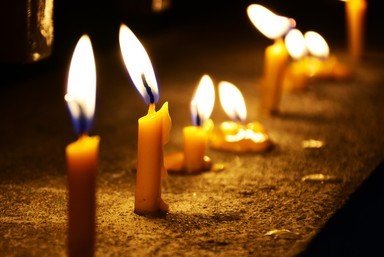
Our house did not have any electric lighting, because electricity had not yet reached our village when I was young.
There was a small gas works in the village but only the more well to do could afford to have it installed, and most of the houses were lit by oil lamps and candles. Very often in those hard times in the winter only the light of the open fire was all there was to do whatever had to be done.
We in our house were a bit better off than a lot of people because my father who worked in the mines used to bring home tallow candles once in a while.
During those long winter nights Father or Mother would read to us at least while we were young, and even after we were quite grown up they would still read books to us. It was better for one person to read, then the candle could be concentrated in one place, and in any case we liked it better that way.
Mother would most often read poetry, the sad kind, like "Somebody's Mother" or "Mary go and call the cattle home". Father on the other hand would read novels, "A Christmas Carol" or some other Dickens books. "Barriers Burnt Away" was another he read to us, "Uncle Tom's Cabin" another, and that was a great favourite.
Considering he left school when he was about eleven years old he was a very good reader, he could put a lot of feeling into whatever he attempted. I well remember how in the very sad parts we would all be weeping and he would have to stop quite often to wipe his spectacles or blow his nose. On the other hand in the happier parts and the funny parts he had to stop just as often to steady up and stop laughing.
Sometimes we sat and sang. We were taught the old songs, songs which Mother or Father had sung when they were young. Perhaps that is why I can't get on with modern jazz. I remember how Dad would say when he heard us singing the songs which came out when my sisters and I were young "You don't want to sing such daft songs as that you should learn a decent song, like Annie Laurie or The Old Rustic Bridge".
True like the youth of today we preferred the modern ones, but I am afraid they have not lasted so well as the songs our parents taught us, and I fancy the songs of today will fade just as quickly, or at least most of them will.
Talking of candles as I am supposed to be, there are on the Alter table in the church where I attend now, two tall white candles, and I often light them for evening service, and as I do so I very often think of the candles we used at home and which my Father used to bring home from his work. What would Mother have given for candles like these, tall and straight and clean looking. Ours were tallow candles, they were grey rather than white and misshapen, thin at one end and thick at the other. They did not burn evenly and it was difficult to stop the grease running all over the place.
I well remember Mother kneeling down with a piece of brown paper and a hot iron getting the grease off the carpets, particularly the stair carpet which seemed to suffer the most as we always had to have a candle to go to bed with.
It wouldn't be very difficult these days with electric irons, but in those days it meant heating the heater in an open fire. That might take an hour or more, then it had to be got out of the fire with a pair of long tongs and juggled into the box iron when it was glowing hot. It didn't last very long either, no wonder she was always telling us to "be careful with that grease".
One other book Dad read to us about that period was "The Wild Dog Of Ennerdale". Ennerdale was only a few miles away from our village, the dog was an enormous animal quite as big as a donkey. To carry away a sheep was nothing for it to manage, and a child: well who knows what a dog that size would carry if it were hungry. I remember how nervous I was for some time after Dad read it to us.
Perhaps if there wasn't a book being read to us Dad would tell us of some of his experiences during his earlier life, his life in the various pits. He was what is called a Snicker, meaning he sank the pit shafts of a number of pits. It was very dangerous work and often things went wrong. He made my hair stand on end and I think he used to tell me these stories to frighten me so that I would not go down the pit to work, and he succeeded, I never did go down a pit.
I am quite sure that if I were to work down a mine I would be quite at home in as much as I would know just what it would be like down there, Father's descriptions were very vivid.
He talked of caving ins and roof falls, of floodings, and of being fast down. Of robberies as he called them, places where the men could make no money because of the hard rock and went home with just a few shillings for a week's hard work, they were paid by how much ore they got out not how much rock they had to move to get it. He talked of drifts where they drove a road from one worked out place to another, then they were paid on how far they drove the drift no matter how hard the rock was. They worked by candlelight sticking the candle on a ledge of the rock, and very often working wet through all the shift. A terrible job, I'm always in sympathy with the miners now when they talk of going on strike for more money, whatever they are paid it isn't too much.
I remember the last time he was fast down. I was at home then, and I remember the anguish only too well. He was fastened down that time for four days and nights, along with two other men. I believe the cage rope had broken.
Each day someone who had been at work trying to get the rope repaired would call at our house and say that Dad was alright and might get out the next shift. There were three shifts so that we at home lived from shift to shift. Four days is a long time when no one can tell what is going to happen a thousand feet or so down in the bowels of the earth.
On the fourth day they were got out. Mother and I went to meet him along the Moor road, we met him a mile or so out of the village, and I will always remember the the meeting of Mother and Father, I need not have been there for some minutes. This was not the first time this had happened either. He had ridden home on his bike after being down there without food or warmth all that time. Water there would be, because there was the danger of flooding I remember, so at least they would not be thirsty. These days there would be an ambulance to have brought him home. Even in those days there would be some means of transport but it was only about seven miles and he was only a miner after all.
Up to now this has not had much to do with candles, but it fills the pages that makes towards a story. Although I am really recording what Father told us on a number of occasions when he was in a talkative mood. The story won't be half as good as it was when he told it because he was Irish and they tell a good tale, particularly if it is against themselves. Dad's blue eyes used to twinkle as he told it and "be careful with the candles" was a household joke all the time we were at home.
The candles were bought by the small company of men who worked together in a gang. If there were any saved then each man took them home in turn. They waited until there were fifty which was a full packet, and we got a packet about every month or six weeks. They were in a strong brown paper packet, it was greased and more or less waterproof. It was quite a good sized packet. When Dad brought them he carried them slung on his back on a piece of strong cord, always the same cord, it was kept for the job.
Father worked three different shifts. On the first shift he arrived home about four o'clock in the afternoon, on the second shift about one o'clock in the morning and about seven a.m. on the third one. His journey to work was across the Moor, a journey of seven miles or so. The road was hilly and a good part of it had to be walked, it being too steep to ride a bike. It was also a haunted road, so legend said. It was certainly a wild road when the wind was off the sea as it most often was. Running more or less east and west as it did, there was no shelter at all.
Devil's Bridge was half way along in the bottom of the Moor and a house stood close by. The person who lived there was quite a frightening figure to we young folk, though Dad said that he was so nervous he was afraid of his own shadow. We were not so sure. He had a flowing beard and always walked very slowly. His house was the only one on the Moor and we always gave it a wide berth whilst we were young.
A mile or so further on, where the road dropped steeply down to the next town and was one of the parts of Dad's journey which was far too steep to ride up when he was returning from work, stood the first of two houses. They were stone houses with mullioned windows, built of sandstone. I always thought of them as mysterious places. There were tall iron gates leading to each one, shrubs and trees screened them from the passer by and I don't think I ever saw any sign of life at either of them. Opposite a little higher up the hill were the head gear and slag bank of a worked out mine, one which Dad had helped to sink maybe years before this story was told or enacted. A deep quarry was also by the side of the road, just by the old pit.
Father must have passed along this part of the road many thousands of times and it would hold no fears for him. Him being a grown man as well, but even for grown up people some things can be quite frightening when darkness comes and our sight is not much use to us.
I ought to tell you of the lamps people used used in those days, lamps on bikes I mean. There were few battery lamps as we use now, they were either paraffin or carbide lamps. Dad used the carbide lamp, they were far better than the oil ones. They were perhaps a little expensive to run but they gave a much better light and they didn't blow out in the wind. The carbide was in a container at the bottom of the lamp, and water in a separate container above it. The water when it reached the carbide made a highly inflammable gas, and could be regulated quite accurately and the light could be adjusted very easily. It took a few seconds for the water to act on the carbide so it necessitated a little forethought when adjusting the light, so saving carbide. But it was quite easy to manage and was really an excellent light, for cyclists.
The turn came for Father to bring home the candles. It was the week he was working the second shift and coming home about midnight. The night was like that Robert Burns talks about when Tam O'Shanter and his good mare Meg made the journey past the Kirk at Alloway: "That night a child could understand, The Diel had business on his hand".
A gale off the sea, a deluge of rain and the night as black at the pit. If you have never been down a pit you don't quite know how dark black is, there isn't any night quite so dark that there isn't some light. A thousand feet down in the bowels of the earth there is no light and it is black. Such was the night when Dad set off home, with candles slung over his shoulder, wrapped in oilskin, and thick clothes against the cold and wet.
The first part of the journey accomplished off the fells and through the little sleeping town of Egremont, up to the first of those two old mysterious houses, where he dismounted to breast the steep hill against the gale blowing in his face. Midnight, that hour when Ghosts take their exercise, when Witches are abroad to confound and frighten anyone foolish enough to be out of their bed, Leprechauns, Goblins and such like, not a time for anyone with any imagination at all to be far from home. The kind of night when the Wild Dog of Ennerdale would take a sheep out of the flock and carry it away.
His lamp now turned low, the road was straight and he knew it well, having tramped it for many years, in fact most of his life. I believe Mother and he did most of their courting about here. The dykes at each side of the road were high gorse, or as we call it whin bushes, they were bending and swaying in the gale, and they took on weird shapes as they were seen against the night sky.
He trudged on bending against the gale and the steep hill, only the sound of the rain beating on his sou'wester and the wind blowing in his face. He was like an island separated from the rest of the world so to speak. I can't think clearly in the wind, perhaps he was like I am, strong wind moiders me. I'm sure it could drive one mad to be out in it for any length of time.
Past the second old house and on towards the derelict mine with its slag heap and old head gear. He couldn't see these now but he was aware of them, up to the quarry and and the steepest part of the hill. He hurried on, eager to get out of the storm, into a place of warmth, tired both physically and mentally.
Something touched the back of his leg and he half stopped, and thinking it would only be the branch of a tree blown off by the gale, went on a little quicker, aware that it was something off, or at least something different.
His lamp was almost out and he wondered whether to turn it out altogether and risk being able to light it at the top of the hill, it would save a little carbide. Better to keep it lit in case his matches were wet. It gave hardly any light at all.
Again that sudden touch on his leg, the same leg in just the same spot. This time he did stop and turned looking over his shoulder, only to see the same darkness. He felt down at his leg, finding only the wet leggings. Now not quite so sure that it was only something blown on to the road. He bent again to the hill, and a third time the knock on his leg came. Alarmed now, he swung round pulling the bike with him, nothing but the whin bushes laying almost flat in the gale, he felt even more alone. He stopped this time for some seconds turning the water in his lamp a little more. It would take some time for it to affect the light and he decided to be prepared the next time. He would make a grab for it and maybe catch whatever it was. Knowing what it was would be better than uncertainty.
He went on again and after a few more steps the same touch again. This time two knocks. He grabbed and swung round quickly. No sign of any thing. He shouted "By God if I get my hands on you I'll kill you," and he stood really alarmed, the sweat standing on his brow and hair beginning to rise on the back of his neck, all kinds of thoughts going through his head. Both sight and hearing were useless to him in these conditions. Only the swaying gorse on the one side and and the old quarry on the other.
The lamp was at last getting brighter and he was near the top of the hill. Getting on as quick as possible, he set off hurrying now, fear lending new energy to his tired legs.
A few more steps and again the dreaded tap. On the same leg, always the same leg, almost in the same place. He swung the bike round, now certain that he would see whatever it was, the lamp had at last brightened up. He shone it on the sides of the road and the dyke tops. There was nothing there at least within reach of the beam of the light. He went to each side of the road in turn and shone the light up into the dyke bottom, the rain running off his hooked nose and glistening in the beam of light. He stood for some time perplexed and at last deciding that discretion was the better part of valour he turned and made for the top of the hill as fast as he possibly could.
Before he reached the top the touch came again, and fearful though he was he had to stop and swing the light round and peer into the side. The lamp was much brighter now, the beam reaching twenty yards or more. Still no sign of anything human, he decided it must be something supernatural. He turned once more home, and as he did so something a few yards away shone white in the lamp rays. He approached it slowly, and as he drew near to it there lay a candle.
He felt round on his shoulder and realised at the same time that the weight was much lighter than it ought to be, only half the candles were left in the packet. The rain had soaked the paper and part of the bottom had fallen out.
He laughed, not a very convincing laugh. He was glad that no one had been there to hear him shouting, on the top of that wild Moor with no one within four or five miles of him. It had not been very funny. Tying the remaining candles securely he made the top of the hill and mounting the bike rode off, relieved at last that he could still scorn the thought of the ghostly and supernatural, and yet the whole thing had a sobering effect on him.
He related later that when he got to Devil's Bridge which was a mile further on and at the bottom of a steep hill, he didn't touch the brakes at all, but just let the bike go as fast as it would, not that he was afraid, but why brake when he was already late, and wasn't the the wind in his face and a long pull up the other side of the brow, past the lonely little house where the man lived with the flowing beard, who was afraid of his own shadow?
---------